

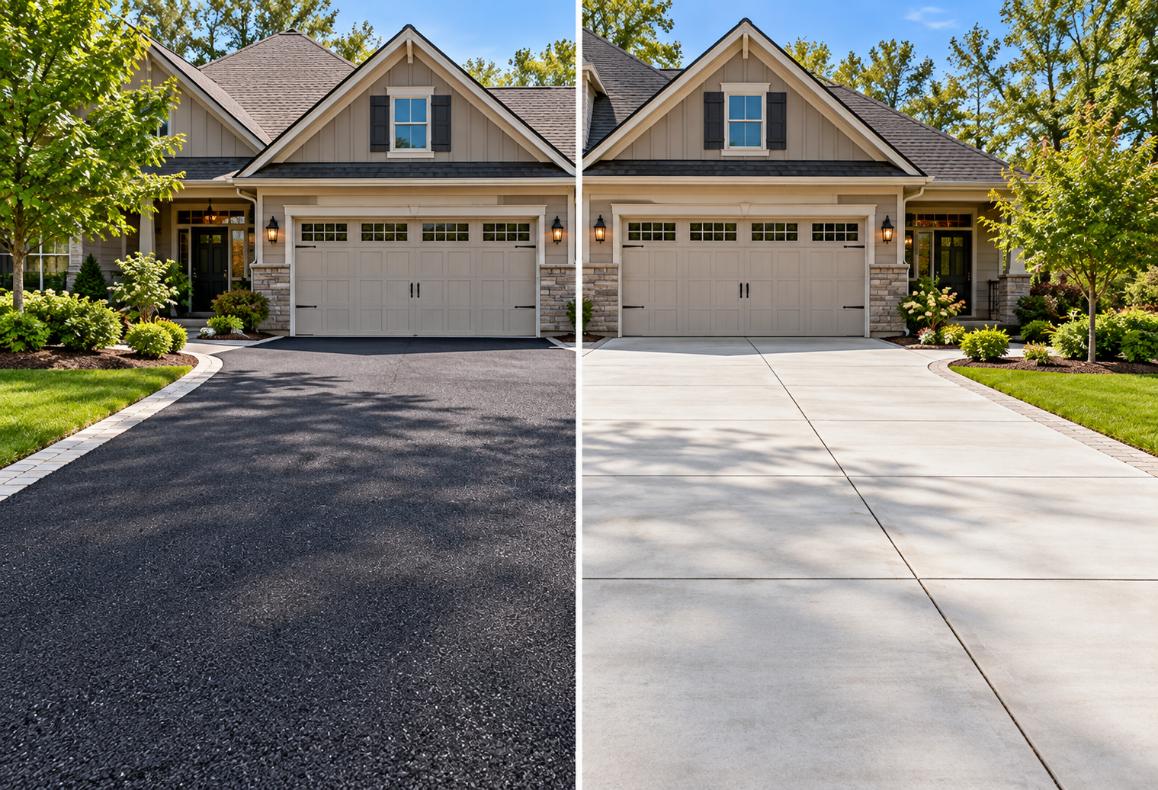
Choosing between asphalt and concrete for a driveway in Montgomery, TX is not just a question of appearance or upfront price. Local heat, periods of heavy rain, drainage, soil conditions, tree cover, and the way a driveway is prepared all affect how well either surface performs.
For Montgomery County homeowners, the material matters, but the base beneath it and the way water moves around it can matter just as much.
Quick answer: Concrete is often the better fit for homeowners who prioritize a rigid, finished surface and lower routine maintenance, while asphalt can make sense for longer driveways, larger paved areas, or properties where flexibility and future resurfacing are priorities. In Montgomery, the right choice should also account for drainage, subgrade conditions, driveway length, vehicle loads, and the condition of the connection to the road.
What local homeowners should know
-
Concrete provides a rigid surface, while asphalt has more flexibility and typically requires periodic maintenance as it ages.
-
Montgomery County contains multiple soil types, so base preparation should be based on conditions at the individual property rather than assumptions about the entire county.
-
Drainage deserves special attention on properties around Lake Conroe and throughout the county because water reaching an inadequately prepared base can contribute to pavement problems.
-
Long rural or semi-rural driveways around Montgomery, Magnolia, and Willis can have different cost and construction priorities than short subdivision driveways.
-
The driveway’s connection to a public road may be subject to requirements from the agency controlling that roadway.
Why Does Driveway Material Matter in Montgomery County?
Driveway material matters in Montgomery County because pavement must handle Texas heat, substantial rainfall events, changing ground moisture, and site-specific soils while continuing to support vehicle traffic. Concrete and asphalt respond differently to these conditions, which is why there is no single material that is automatically right for every local property.
USDA soil information shows that Montgomery County is not made up of one uniform soil. Mapped soils include Conroe loamy fine sand, Splendora fine sandy loam, clay soils, and other soil types with different drainage and structural characteristics.
That variation makes site preparation particularly important.
Randy Roan Construction Inc. helps property owners evaluate paving and construction needs in the Montgomery area. We look beyond the surface material to consider how the driveway will be used and what the site requires.
What Do Local Soil and Construction Standards Tell Us?
Local soil information and Montgomery County construction standards reinforce the importance of preparing pavement from the ground up. County development regulations for public roadway construction require organic material to be removed and subgrades to be shaped and compacted, illustrating how seriously proper support beneath pavement is treated in local construction.
A residential driveway is not automatically subject to every specification written for a county road, but the underlying principle is useful for homeowners: good pavement needs a suitable foundation.
USDA Natural Resources Conservation Service mapping also shows significant soil variation across Montgomery County. Conditions can change between properties, so a driveway in Woodforest may not have exactly the same preparation requirements as acreage near FM 149, Lake Conroe, or a property closer to Conroe.
How Does Asphalt Perform on Montgomery County Driveways?
Asphalt can be a practical driveway material in Montgomery County because it provides a flexible paved surface and works particularly well when homeowners need to cover a long or substantial driveway area. Its performance, however, depends heavily on drainage, base preparation, installation quality, and ongoing maintenance.
Asphalt’s flexibility can be useful where minor ground movement occurs. It can also be resurfaced when the existing pavement and base remain suitable.
Homeowners should expect asphalt to change in appearance as it ages. Texas sun and heat can contribute to surface aging, while cracks that develop should be addressed before water repeatedly reaches the underlying base.
For larger properties outside central Montgomery or along the rural roads toward Magnolia and Willis, the size and length of the driveway may make asphalt worth comparing closely with concrete.
How Does Concrete Perform on Montgomery County Driveways?
Concrete provides Montgomery homeowners with a rigid, durable driveway surface that can be an excellent choice for residential entrances, parking areas, and frequently used driveways when the base and drainage are properly designed. It also offers the clean, finished appearance many homeowners prefer around newer homes.
Concrete is rigid rather than flexible, so preparation and joint placement matter. If the supporting material settles unevenly or water creates problems below the slab, cracking or displacement can occur.
Concrete can be particularly attractive for homes in developed communities such as Woodforest and neighborhoods near Lake Conroe where the driveway is a prominent part of the front of the property.
Homeowners should remember that concrete is not crack-proof. Proper construction is intended to manage movement and reduce unnecessary problems, not promise that a slab will never develop a crack.
What Warning Signs Suggest a Driveway Needs Attention?
Driveway cracks, standing water, settlement, broken edges, surface deterioration, and uneven transitions are signs that a Montgomery County driveway should be evaluated. Some problems remain mostly cosmetic, while others indicate drainage or support issues that can continue worsening below the pavement.
Watch for:
-
Cracks that continue widening or multiplying.
-
Water that regularly ponds on the driveway after storms.
-
Low areas that appear to be settling.
-
Concrete sections that are no longer level with adjoining sections.
-
Asphalt edges that crumble or lose support.
-
Depressions or wheel-path areas that hold water.
-
Damage where the driveway meets the road or culvert.
-
Soil erosion along either side of the driveway.
Water-related symptoms deserve particular attention because simply covering a crack does not correct a drainage or base problem underneath it.
When Should You Call a Driveway Professional?
Call a driveway professional when deterioration involves settlement, recurring drainage problems, widespread cracking, base failure, major surface damage, or a driveway that may need replacement rather than another temporary repair. Small surface changes can be monitored, but structural or drainage problems deserve a closer look.
Homeowners can safely keep the pavement clean, watch how water drains after rain, and monitor whether existing cracks are changing.
Professional evaluation becomes more valuable when sections are sinking, water repeatedly collects in the same location, the edges are failing, or the entire surface has reached the point where repeated repairs are no longer practical.
What Commonly Causes Driveway Problems Around Montgomery?
The most common driveway problems around Montgomery are connected to water, inadequate base preparation, soil movement or settlement, heavy vehicle loads, aging pavement, and poor edge support. More than one cause can be present at the same property.
Water is a major consideration. A driveway should direct runoff appropriately instead of allowing it to sit on the pavement or repeatedly reach vulnerable areas along the base.
Subgrade preparation is another factor. A beautiful surface placed over unsuitable or poorly compacted material can still develop problems.
Heavy vehicles can also matter. Properties receiving trailers, RVs, work trucks, equipment, or frequent delivery vehicles may place very different loads on a driveway than a home used only by passenger vehicles.
Finally, roots, erosion, culvert conditions, and poorly supported pavement edges can create localized trouble on wooded or larger lots common around the Montgomery area.
How Can Homeowners Extend Driveway Life?
Montgomery homeowners can help extend driveway life by controlling drainage, addressing cracks and surface damage early, protecting pavement edges, and avoiding unnecessary loads that exceed the driveway’s intended use. Maintenance should focus on keeping small problems from becoming pathways for water and further deterioration.
After major rain, look for standing water and erosion along the driveway. Keep drainage paths and driveway culverts clear where homeowners can safely do so.
For asphalt, periodic maintenance may include crack repair and other surface treatments appropriate to its condition. For concrete, monitor joints, cracks, settlement, and drainage.
DIY maintenance should stop when the problem appears structural or requires excavation, grading, substantial pavement removal, or reconstruction of the base.
What Results Should You Expect From a New Driveway?
A properly planned new driveway should provide a stable driving and parking surface, move water appropriately for the site, and match the property’s expected vehicle use. The realistic goal is durable pavement designed around local conditions, not a surface that will remain completely unchanged forever.
For Montgomery properties, that means paying attention to what is underneath the pavement as well as what is visible on top.
A good project plan should consider driveway slope, drainage, base conditions, pavement material, transitions, expected loads, and access to the roadway.
What Driveway Mistakes Should Montgomery Homeowners Avoid?
The biggest driveway mistakes are choosing on price alone, ignoring drainage, underestimating base preparation, and treating every crack as a surface-only problem. These shortcuts can undermine either asphalt or concrete.
Mistake: Choosing the least expensive surface without considering the site.
Consequence: The material may not match the driveway’s size, loads, drainage, or maintenance expectations.
Better approach: Compare complete construction options rather than surface material alone.
Mistake: Paving over an unresolved drainage problem.
Consequence: Water may continue affecting the pavement or supporting material.
Better approach: Plan drainage before installing the final surface.
Mistake: Ignoring the driveway edges.
Consequence: Unsupported edges can deteriorate under traffic.
Better approach: Include edge support and surrounding grade in the project plan.
What Is a Common Montgomery County Driveway Scenario?
A common Montgomery County scenario is a homeowner with an aging driveway who wants to replace it but is unsure whether switching materials will actually solve the existing problems. The correct answer starts with determining why the old driveway deteriorated.
For example, imagine a property outside Montgomery with a long driveway showing cracks, low spots, and recurring puddles after storms. Simply choosing concrete instead of asphalt, or asphalt instead of concrete, does not necessarily address the underlying issue.
The site should first be evaluated for drainage, base condition, grade, traffic, and failed areas. Only then does the material comparison become meaningful.
Which Driveway Services Can Address These Problems?
Driveway construction, paving, replacement, base preparation, grading, and related site work can address different parts of a failing driveway, depending on what an inspection finds. Some properties need targeted work, while others are better candidates for substantial reconstruction.
We can help property owners compare practical options based on the driveway itself rather than assuming one material is always superior.
Asphalt vs. Concrete: Which Option Is Better?
Concrete is often the better choice for homeowners prioritizing a rigid finished surface and reduced routine surface maintenance, while asphalt may be attractive for long driveways, larger areas, and owners comfortable with periodic pavement maintenance. The better value depends on the complete project.
| Factor | Asphalt | Concrete |
|---|---|---|
| Surface type | Flexible pavement | Rigid pavement |
| Large driveway areas | Often worth considering | Can also be used |
| Routine maintenance | Typically requires periodic attention | Generally less surface maintenance |
| Repair approach | Patching or resurfacing may be possible | Individual damaged areas may require concrete repair |
| Appearance | Traditional dark paved surface | Clean, finished slab appearance |
| Key local concern | Heat, drainage, base condition | Drainage, base condition, joints, settlement |
| Best choice | Site-dependent | Site-dependent |
For a Montgomery County home, comparing bids only by total price can hide important differences in excavation, base preparation, thickness, drainage work, and site access.
Where Do We Serve Around Montgomery?
We serve homeowners in Montgomery and surrounding communities where driveway construction and paving solutions are needed. Relevant nearby areas can include Conroe, Magnolia, Willis, Lake Conroe communities, and other parts of Montgomery County depending on project location and service availability.
What Can Happen If You Ignore Driveway Damage?
Ignoring driveway damage can allow water intrusion, erosion, settlement, cracking, and edge deterioration to become more extensive and potentially more difficult to repair. The risk is greatest when the visible damage is being caused by a continuing drainage or base problem.
A small cosmetic crack is different from a low section that collects water after every storm. Watching how the driveway behaves during wet weather can help Montgomery homeowners distinguish between minor aging and a developing site problem.
FAQ
Is asphalt or concrete better for a driveway in Montgomery, TX?
Neither material is automatically better for every Montgomery, TX driveway. Concrete may appeal to homeowners seeking a rigid, finished surface with less routine surface maintenance, while asphalt can be attractive for long or large driveways. Drainage, base conditions, traffic, property layout, and budget should guide the final choice.
Does Montgomery County soil affect driveway construction?
Yes, Montgomery County soil can affect driveway construction because soil characteristics vary across the area. USDA mapping identifies sandy, loamy, and clay-influenced soils throughout the county. The condition at the individual property is more useful than a countywide assumption, especially when planning excavation, base preparation, drainage, and pavement.
Is asphalt suitable for the Texas heat in Montgomery?
Yes, asphalt can be used successfully in the Montgomery area when the pavement structure, installation, drainage, and maintenance are appropriate for the site. Texas heat should still be considered because pavement temperature and long-term weather exposure affect asphalt. Homeowners should evaluate the complete pavement system rather than rejecting asphalt solely because of summer heat.
Is concrete maintenance-free in Montgomery, TX?
No, concrete driveways in Montgomery, TX are not maintenance-free. Homeowners should still monitor cracks, joints, drainage, settlement, stains, and changes around pavement edges. Concrete generally requires a different type of maintenance than asphalt, but both surfaces benefit from catching water, support, and deterioration problems before they become more extensive.
Do I need a permit for a new driveway in Montgomery County?
Permit requirements depend on the project’s location, roadway, and scope, so homeowners should verify jurisdiction before construction begins. If driveway work affects access to a Texas state highway right-of-way, TxDOT requires an approved driveway permit before construction on that right-of-way. Local or other roadway requirements may differ.
Does drainage matter for Lake Conroe-area driveways?
Yes, drainage should be part of driveway planning around Lake Conroe and throughout Montgomery County. The goal is to keep runoff moving appropriately rather than allowing repeated ponding or erosion around the pavement. Drainage design is property-specific, so slope, ditches, culverts, surrounding grade, and discharge paths should all be considered.
Can I put concrete over an old asphalt driveway?
Installing concrete over an existing asphalt surface should only be considered after evaluating the existing pavement and underlying support. Covering a failed surface does not automatically correct poor drainage, settlement, or weak base material. For a Montgomery property, the better approach is to determine why the old driveway failed before selecting the reconstruction method.
Is asphalt cheaper than concrete in Montgomery, TX?
Project-specific pricing is required to determine which option costs less for a particular Montgomery, TX property. Driveway length, width, excavation, base preparation, drainage, pavement design, access, demolition, and material quantities can all affect the total. Homeowners should compare the complete scope of work rather than relying on a generic price-per-square-foot estimate.
Choose a Driveway Built Around Your Montgomery Property
The best driveway material is the one that fits the property, traffic, drainage, ground conditions, maintenance expectations, and budget. For local homeowners, choosing between asphalt and concrete should begin with the site rather than with a generic rule.
Build a Driveway That Fits Your Property and Long-Term Plans
We can help you evaluate the conditions that matter before deciding how to move forward with your Montgomery-area driveway.